Overview
Abstract
Large Language Models (LLMs) are increasingly used as proxies for human perception in urban analysis, yet it remains unclear whether persona prompting produces meaningful and reproducible behavioral diversity. We investigate whether distinct personas influence urban sentiment judgments generated by multimodal LLMs. Using a factorial set of personas spanning gender, economic status, political orientation, and personality, we instantiate multiple agents per persona to evaluate urban scene images from the PerceptSent dataset and assess both within-persona consistency and cross-persona variation. Results show strong convergence among agents sharing a persona, indicating stable and reproducible behavior. However, cross-persona differentiation is limited: economic status and personality induce statistically detectable but practically modest variation, while gender shows no measurable effect and political orientation only negligible impact. Agents also exhibit an extremity bias, collapsing intermediate sentiment categories common in human annotations. As a result, performance remains strong on coarse-grained polarity tasks but degrades as sentiment resolution increases, suggesting that simple label-based persona prompting does not capture fine-grained perceptual judgments. To isolate the contribution of persona conditioning, we additionally evaluate the same model without personas. Surprisingly, the no-persona model sometimes matches or exceeds persona-conditioned agreement with human labels across all task variants, suggesting that simple label-based persona prompting may add limited annotation value in this setting.
Key Results
Agreement with human labels holds up on coarse polarity and falls away as the sentiment scale gets finer. Removing the persona does not cost anything: on every task variant the no-persona model matches or exceeds the persona-conditioned pool.
| Task granularity | Persona agents | No persona |
|---|---|---|
| Binary · 50 imagesPolarity (negative vs. rest) | 0.807 | 0.862 |
| Binary · 50 imagesPolarity (positive vs. rest) | 0.797 | 0.836 |
| Three-class · 45 imagesNegative / neutral / positive | 0.588 | 0.665 |
| Ordinal · 36 imagesFive-point sentiment scale | 0.309 | 0.433 |
- Behavior within a persona is stable. Across the 1,200 image × profile groups, a median 98% of the 50 agents sharing a profile pick the same label; the mean modal ratio is 0.871 [0.860, 0.881].
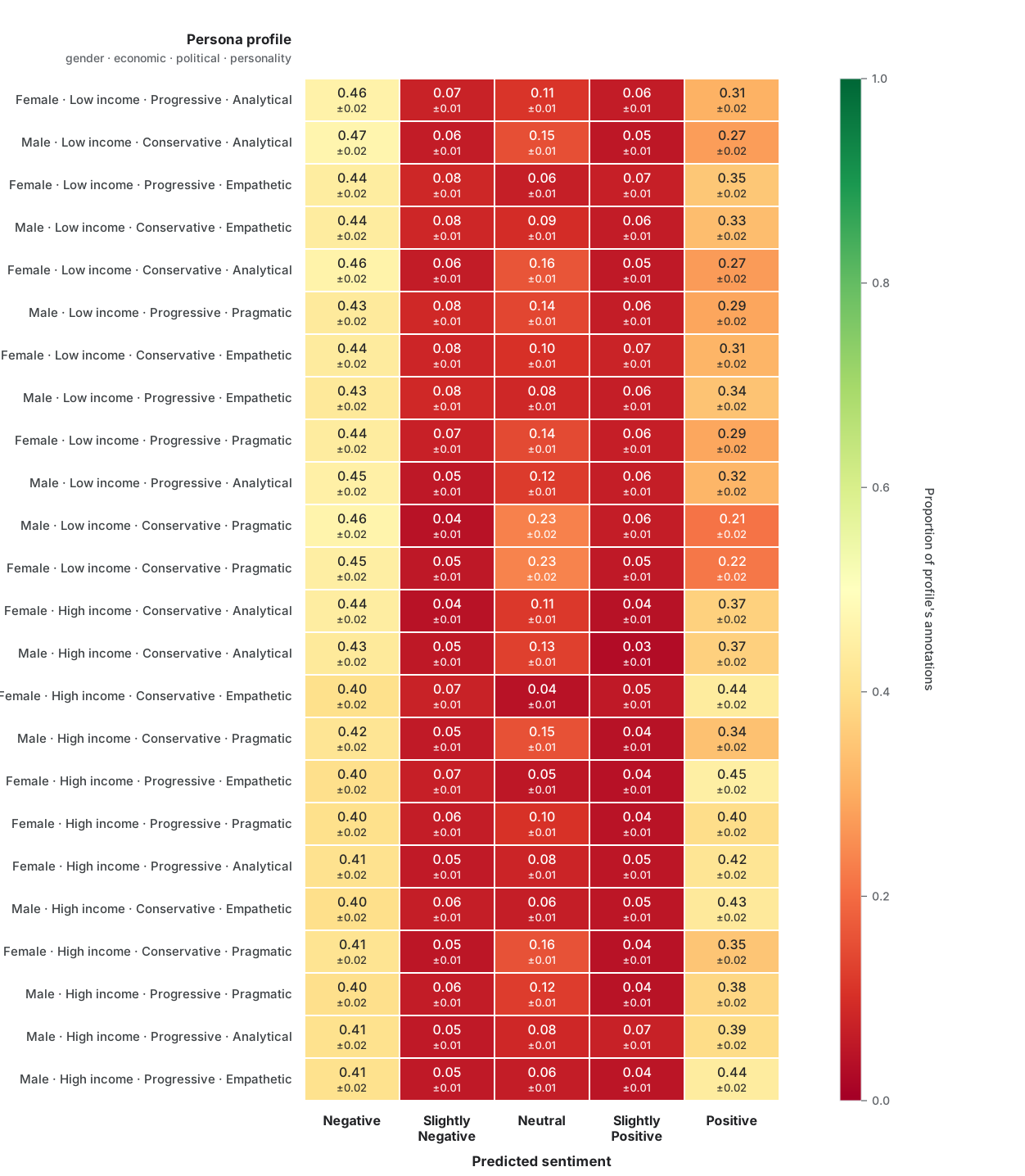
- Behavior across personas is not distinct. Economic status is the only dimension with a clear shift — low-income profiles skew negative, high-income profiles positive — while gender and political orientation produce overlapping distributions.
- Agents avoid the middle of the scale. Negative and Positive absorb 77.4% of the 59,708 annotations, while the human ground truth spreads almost evenly over all five levels.
- Errors are adjacent, not opposite. Quadratic Cohen κ stays near 0.79 on the five-point task: the ordering is right even where the exact level is wrong.
Study at a Glance
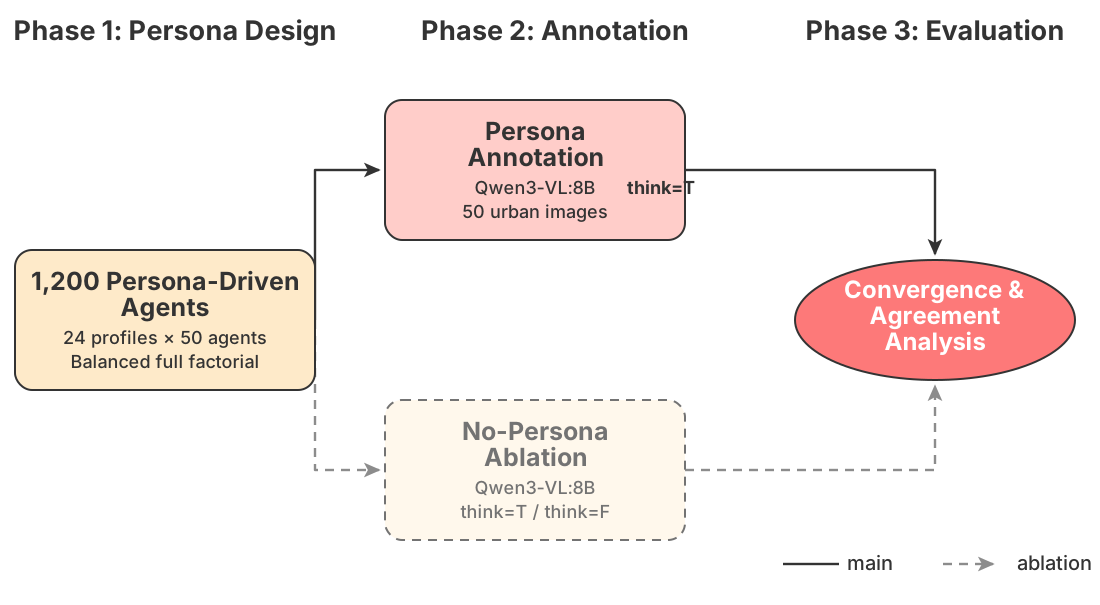
The 24 profiles are the full factorial of gender (2), economic status (2), political orientation (2), and personality (3), with 50 agents drawn per profile and every dimension perfectly balanced. Each agent annotates all 50 images with Qwen3-VL-8B, returning a five-point sentiment label, perception tags, a caption, and a justification. Convergence is measured as the within-group modal ratio over the 50 agents in each image × profile cell. Agreement with humans is evaluated against 12 PerceptSent subsets filtered at three annotator-agreement thresholds, with point estimates from a 60% annotation resample per image and 95% intervals from an image-level bootstrap. The same model and images are rerun without persona conditioning, in reasoning-enabled and reasoning-disabled variants, as the ablation.
Every annotation behind these results is released as UrbanPersona-60K on Hugging Face: the 59,708 persona-conditioned labels with their perception tags, captions, and justifications, the no-persona ablation runs, and the 1,200 persona seed profiles, under CC BY 4.0.
Responsible Interpretation
These results describe how one model behaves under persona prompts; they are not estimates of how real demographic groups perceive cities. The profiles are controlled prompting conditions built from four attribute labels, not complete identities, and synthetic personas can reproduce stereotypical associations. The negative finding is about label-based persona prompting specifically — a richer persona representation, a different model, or a different task may behave differently. Substituting agents for human annotators would require demographically matched human data to justify.
Citation
If this work informs your research, please cite the UrbCom paper.
@inproceedings{urbcom26-neemias,
  title={Stable Behavior, Limited Variation: Persona Validity in LLM Agents for Urban Sentiment Perception},
  author={Neemias B da Silva and Rodrigo Minetto and Daniel Silver and Thiago H Silva},
  year={2026},
  booktitle={Proc. of IEEE DCOSS-IoT-UrbCom},
  address={Reykjavik, Iceland}
}